The 30-day Beginner's Blueprint exercise program is catered to true beginners that want to change their habits, can be done at home with little or no equipment, and only consists of two short resistance workouts per week plus low-impact walking you can do anytime and anywhere. It will put you on the path to losing weight and achieving the body and health you want – all with minimal time investment.
If you didn’t know where to start before, now you do. Start right here!
Beginner's Blueprint Program Overview
The Beginner's Blueprint program is a 4-week plan consisting of only two resistance workouts per week for the first three weeks, and then adding a third resistance workout in the fourth and final week. The other days of the week are “off days” from working out, though low-intensity walks are recommended to keep you staying active.
Every resistance workout in the Beginner's Blueprint program is a full-body routine, where all major muscle groups are being worked each time out. Full-body workouts are best for beginners, but more than that, this method is ideal for burning maximal calories for faster weight loss results.
What Muscles are Worked with Beginner's Blueprint Workouts?

Beginner's Blueprint workouts were designed to be as efficient as possible, with no wasted movements and no “filler” exercises. In the first two weeks of the program, you’ll be doing only four exercises per workout – one for the lower body, targeting the glutes, quadriceps, and hamstrings; one upper body “push” exercise that will work the chest, shoulders, and triceps; one upper body “pull” exercise that targets the various muscles of the upper back; and one core exercise that targets at least one major area of the midsection (abs, obliques, lower back, and/or other deep core muscles).
Will four exercises per workout be enough to produce results? Absolutely. If it’s been a while since you’ve worked out consistently, it won’t take much exercise volume to initiate changes and increase strength. Plus, those four exercises are collectively hitting all the largest muscles in the body.
Most importantly, you’re establishing a habit. By doing this program, you’re changing your mindset and training your body to start craving being active.
In the last two weeks, you’ll add three exercises to each workout (for a total of seven) – an additional exercise each for the lower body, upper body push, and upper body pull. This step-up in volume is necessary for continued progress, or “progressive overload” as it's called in fitness circles.
The Basics Behind the Workouts – Reps, Weight, Intensity
Three major variables involved in any resistance training program are volume, intensity, and load (weight). Volume refers mainly to the number of sets performed, and intensity and load are closely tied to the number of reps you do in each set. In the Beginner's Blueprint program, the sets range from 2 to 4 per exercise, and reps range from 8 to 15.
Where load is concerned, you want to use a heavy enough weight on a given set to challenge your muscles, but not so heavy that it causes you to use poor form or puts you at risk for injury.
Load is related to intensity, which is in large part determined by how close you come to “muscle failure” (the point at which your muscles have reached full fatigue and are unable to complete more reps). It’s not necessary to achieve muscle failure on every set, but you should be coming at least somewhat close to failure on all sets outside of warmups; for example, stopping 2 or 3 reps short of failure provides ample intensity, whereas stopping 5 or more reps before failing probably means you didn’t push yourself hard enough. If a set calls for 12 reps and you know you could have easily done 20, you’ll want to increase the weight on the next set.
Let’s circle back to reps for a moment. There’s a very simple progression from week to week when it comes to reps: 8 reps per exercise in Week 1; 10 reps in Week 2; 12 reps in Week 3; and 15 reps in Week 4. The resistance you use for the exercises should more or less stay the same, which means you’ll be doing more work each week – more reps with the same weight.
This is the progressive nature of the program. As you get stronger, you should be able to do more reps with a given weight. If you’re stopping well short of failure in Week 1, that’s fine. By Week 3 or 4 (12 reps, 15 reps), you’ll be working much closer to muscle failure, which means intensity will be higher.
Beginner's Blueprint Exercises (and their benefits)
The Beginner's Blueprint program focuses on major “compound” exercises that target the largest amount of muscle mass. This will help you maximize both calorie burning and strength improvements. Such exercises are also ideal for building muscle, which not only serves the functional purpose of increasing strength, but will also boost your body’s metabolism to help you burn more calories throughout the day. Increasing muscle mass is also highly beneficial for anyone with high blood sugar levels, including type 2 diabetics; the more muscle you have, the more tissue is available for storing glucose.
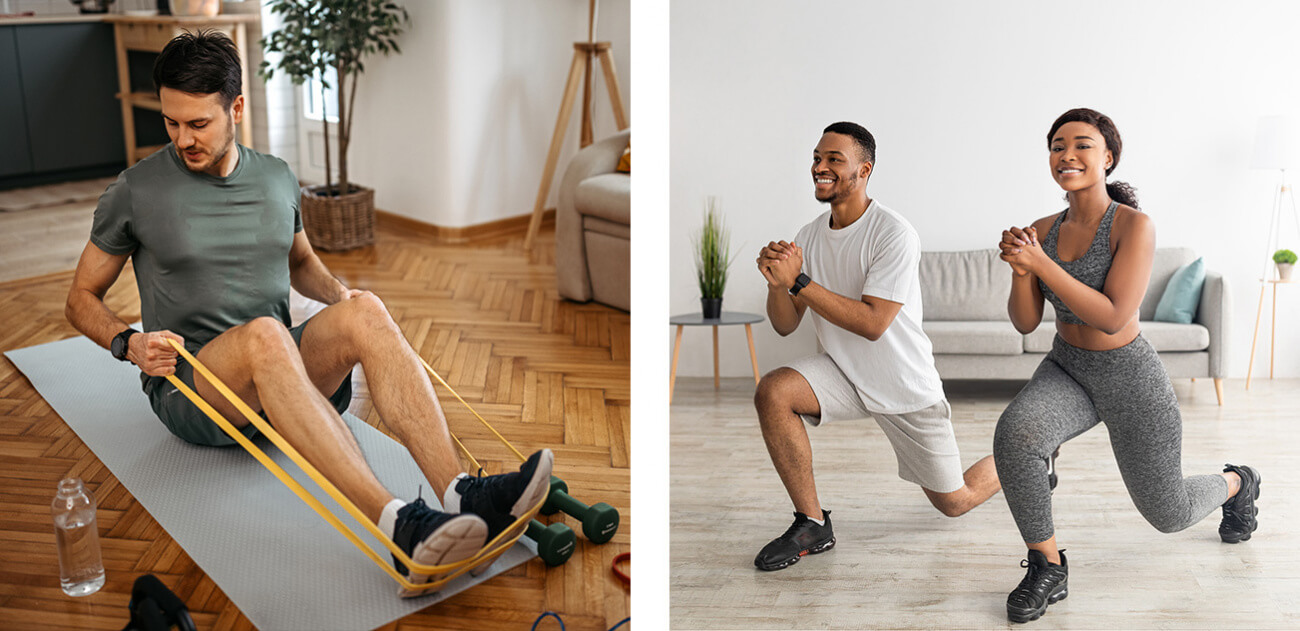
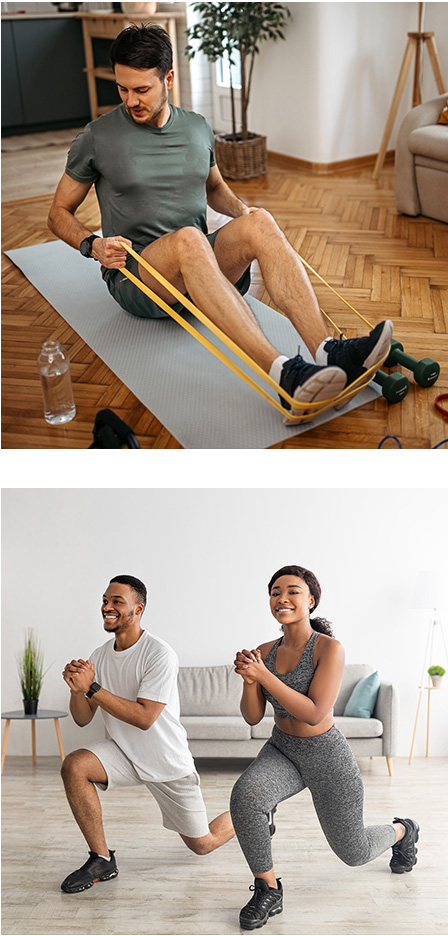
The exercises in the program involve minimal equipment – either bodyweight only (no equipment), light dumbbells, or a set of resistance bands – to allow you to do all workouts at home. The latter two pieces of equipment will require a relatively small initial investment on your part, but that investment will be well worth it for improving your fitness and overall health.
Also notice that there are a variety of different exercises introduced throughout the four weeks. This is done on purpose: To get you acquainted with as many exercises as possible and lay the groundwork for a sustainable, long-term exercise regimen.
All that said, you’ll still be repeating the same basic movements in your workouts. For example, a dumbbell shoulder press and resistance band shoulder press are technically different exercises, but they’re the same anatomical movement. Same goes for a walking lunge and reverse lunge; same basic movement, slightly different variations.
Subtle variations of identical movements are used for a couple different reasons: (1) to make sure all areas of major muscles are being worked, and (2) to keep your workouts from getting “stale.” The more exercise variations you have in your repertoire, the more enjoyable working out will be for you.
If you don’t know how to perform every exercise in the Beginner's Blueprint program, that’s okay! You shouldn’t be expected to. We have an entire video library right here that shows how to perform each exercise.

Steady Progress during the 30 Days
Every week, one or more aspects of the program are made more challenging. But don’t worry, every increase is incremental, making for a noticeable but gradual progression from week to week.
The main progressions in the program involve the amount of work performed (volume); for example, adding one more set to each exercise from Week 1 to Week 2 (2 sets and 3 sets, respectively). Speaking of which, in the fourth and final week of the Beginner's Blueprint program, you’ll do three weekly resistance workouts (M/W/F) instead of two to increase volume one last time.
Added Challenges for Those Who Want It
Throughout the Beginner's Blueprint program, you have options to do a little bit more. For example, where a workout calls for 3 sets per exercise, you could bump that up to 4 sets. Or, you could go for a 25-minute walk instead of a 20-minute walk.
But keep in mind, these additions are truly optional. They’re intended mostly for people who already have some exercise experience and need just a little bit more to progress. If you feel up for doing a little more, go for it! If not, that’s fine too. The workouts as written are sufficient for a vast majority of people.
New to lifting? Start with a plan that tells you exactly what to do
Dr. Jim's beginner programs show you every exercise, set and rep, week by week.
Get My ProgramRelated Articles
-
 Xtreme Shredded 8 (XS8) Program Overview
The advanced version of the classic Super Shredded 8 program will get you super lean and muscular in 8 short weeks.
-
 H.I.P.E. Program Overview
High Intensity plus Pre-Exhaust: Six weeks to your most efficient muscle gains ever.
-
 8-Week Rock Hard Challenge Program Overview
My classic eight-week program will transform your body with more muscle, less body fat, and big strength gains.
-
 The Power of Post-Workout Nutrition: Jim Stoppani’s Recovery Blueprint
Unlock the power of post-workout nutrition with Jim Stoppani’s proven strategies. Learn how to optimize recovery and muscle growth with diet, timing, and Post JYM supplements.

Foundations
-
Featured Meal Plans
-
Muscle Hypertrophy: Build Muscle Fast
-
Rethink Your Rep Range
-
The Science of Strength Bands
Training
- Elbow Pain When You Bench? Try This
- Paused Bench Press: Is It Better for Strength or Chest Growth?
- Workout Plan for Men Over 50: How to Mix Heavy and Light Training
- Workout Plan for Men Over 40: Why Training Age Matters More Than Your Birthday
- Light or Heavy Weights: What’s Better for Men Over 40?
Nutrition
- 3 Reasons Why I’m Not Currently Taking Peptides
- How High School Athletes Should Use Protein Powders
- How Many Carbs Should You Eat to Build Muscle?
- Do Healthy Fats Help You Build Muscle?
- How Often Should You Eat Protein to Build Muscle?
Supplementation
- Why Creatine Hurts Your Stomach—and What to Do About It
- Creatine HCl vs. Monohydrate: Which Form Should You Take?
- 3 Reasons Why I’m Not Currently Taking Peptides
- 5 Creatine Myths Debunked: Kidneys, Hair Loss and More
- 3 Things to Know Before Taking More Creatine
Health
- Can Steroids Cause Your Organs to Grow?
- What Is a Normal Testosterone Level for Men? Here’s What the Research Says
- 5 Ways to Burn Fat Today
- High-Protein Diets and Kidney Disease
- The Truth About Trenbolone